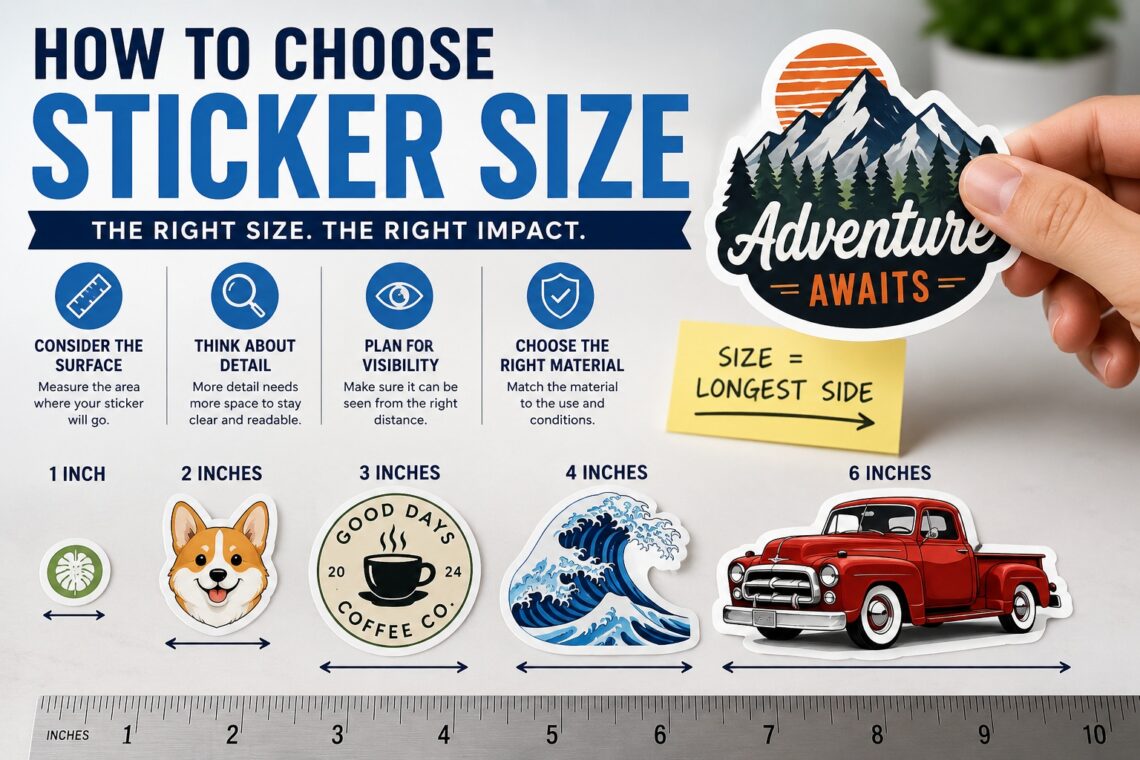
How to Choose A Sticker Size
TLDR
The best sticker size depends on where the sticker will go, how much detail is in the design, and how far away people need to read it.
Small stickers work well for phones, packaging, planners, and product labels. Medium stickers are best for laptops, water bottles, notebooks, and giveaways. Large stickers are better for cars, windows, equipment, coolers, and signs.
When ordering custom stickers, remember that sticker size usually refers to the longest side of the design. A 3-inch die cut sticker may be 3 inches tall or 3 inches wide, depending on the artwork shape.
Start With Where the Sticker Will Go
Choosing sticker size is easier when you start with placement.
A sticker for a phone case should not be the same size as a sticker for a car window. A sticker for a product jar has a different job than a sticker for a laptop. A packaging seal can be small and simple. A bumper sticker needs to be large enough to read from a distance.
So before choosing a size, ask one practical question: where will this sticker be used?
That answer should guide the rest of the decision.
A small sticker can look great on a notebook but disappear on a truck window. A large sticker can look bold on a cooler but awkward on a water bottle. The right sticker size is not just about what looks good in the design file. It is about what works on the actual surface.
What Sticker Size Means When Ordering
Sticker size can be confusing because custom stickers are often cut to the shape of the artwork.
In most cases, the listed size refers to the longest side of the sticker. That means a 3-inch sticker is measured by its longest dimension, not both dimensions.
For example:
- A 3-inch circle sticker is 3 inches wide and 3 inches tall.
- A 3-inch square sticker is 3 inches wide and 3 inches tall.
- A 3-inch die cut logo sticker may be 3 inches wide and 1.8 inches tall.
- A 3-inch character sticker may be 3 inches tall and 2.2 inches wide.
This matters because die cut stickers do not always fit into neat width-by-height expectations. The shape follows the artwork.
When you order custom stickers, the proof helps you see how the sticker will be cut before printing. Always review the proof carefully, especially if the exact finished size matters for packaging, labels, cars, or product inserts.
Small Stickers: 1 to 2 Inches
Small stickers are best when space is limited.
They work well for:
- Phone cases
- Planners
- Journals
- Product packaging
- Small envelopes
- Jar lids
- Lip balm tubes
- Thank-you seals
- Small logo labels
- Event badges
- Craft packaging
A 1-inch sticker is useful for small labels, icons, seals, and simple marks. It is not ideal for detailed artwork or long text. At that size, small details can disappear quickly.
A 1.5-inch sticker gives you a little more room. This is a good size for small packaging stickers, product seals, and simple logo marks.
A 2-inch sticker is one of the most useful small sizes. It works well for packaging, giveaways, small jars, candles, notebooks, and simple brand stickers.
The main rule with small stickers is simple: keep the design clean. Use fewer words, thicker lines, and strong contrast.
Medium Stickers: 2.5 to 4 Inches
Medium stickers are the safest choice for most everyday uses.
They work well for:
- Laptops
- Water bottles
- Notebooks
- Tablets
- Tumblers
- Toolboxes
- Skateboards
- Helmets
- Event giveaways
- Brand stickers
- Artist stickers
- Small business order inserts
A 2.5-inch sticker is a good choice when you want something noticeable but not too large. It works well on smaller water bottles, notebooks, and packaging inserts.
A 3-inch sticker is probably the most common all-around sticker size. It is large enough for logos, characters, illustrations, and short phrases, but still small enough to fit on many common surfaces.
A 4-inch sticker is a better choice when the design has more detail or needs to stand out. It works well for bold brand stickers, laptop stickers, coolers, larger water bottles, and promotional handouts.
If you are not sure what sticker size to choose, 3 inches is usually a safe starting point for a general-purpose sticker.
Large Stickers: 5 Inches and Up
Large stickers are best when visibility matters.
They work well for:
- Car windows
- Bumpers
- Storefront windows
- Coolers
- Toolboxes
- Trailers
- Equipment cases
- Large laptops
- Wall displays
- Event signage
- Large brand decals
A 5-inch sticker can make a strong statement without feeling oversized. It is useful for larger artwork, bold logos, and window decals.
A 6-inch sticker or larger is better when people need to read the sticker from farther away. This is especially true for vehicles, signs, equipment, and business decals.
Large stickers need more open space. Before ordering, measure the surface and make sure the sticker will not feel cramped. A large sticker on a curved bottle may wrinkle or wrap awkwardly, while the same sticker could look great on a cooler or back window.
Best Sticker Size for Water Bottles
Water bottle stickers need to fit a curved surface.
For most water bottles, 2 to 3 inches is the best sticker size. This range is large enough to show the artwork but small enough to sit cleanly on the bottle curve.
Use smaller sizes for narrow bottles. Use larger sizes for wide tumblers, large insulated bottles, or coolers.
Good water bottle sticker sizes:
- 2 inches for small icons or simple logos
- 2.5 inches for most small to medium bottles
- 3 inches for standard water bottle stickers
- 4 inches for large bottles, tumblers, or bold designs
Avoid long horizontal stickers unless the bottle is wide enough. Long designs can wrap too far around the bottle and become hard to read.
Best Sticker Size for Laptops
Laptop stickers have more room than phone stickers but still need to fit around other designs.
For laptops, 2.5 to 4 inches is usually the best range.
A 2.5-inch sticker is good for small logos, icons, and simple artwork. A 3-inch sticker works well for most brand stickers and illustrations. A 4-inch sticker is better for larger art, bold designs, and stickers meant to stand alone.
If the sticker is part of a sticker collection, smaller sizes may work better. If it is the main sticker on the laptop, go larger.
Best Sticker Size for Packaging
Packaging stickers should fit the package without overpowering it.
Common packaging sticker sizes include:
- 1 inch for small seals and tiny product labels
- 1.5 inches for small bags, envelopes, and jar lids
- 2 inches for tissue seals, thank-you stickers, and small boxes
- 2.5 inches for larger bags, candles, jars, and product boxes
- 3 inches for bold packaging labels and gift boxes
For product packaging, measure first. A sticker that looks good on a screen may be too large on a small box or too small on a large mailer.
If you are labeling products repeatedly, roll labels may be more efficient than individual stickers. Circle, square, rectangle, oval, and die cut label options can all work depending on the package shape. You can browse custom labels when the sticker needs to function more like a product label than a giveaway.
Best Sticker Size for Cars
Car stickers need to be readable from a distance.
Small text does not work well on cars. The viewer is usually several feet away and may only glance at the sticker for a second.
Good car sticker sizes:
- 4 inches for simple logos or small window decals
- 5 inches for bolder logo stickers
- 6 inches or more for readable text
- 8 inches or more for bumper-style messages or large window designs
If the sticker includes words, go bigger than you think. A 2-inch text sticker may look fine in your hand but become unreadable on a car window.
For vehicles, simplicity matters. Use bold text, high contrast, and fewer details.
Best Sticker Size for Giveaways
Giveaway stickers need to be useful.
If the sticker is too large, fewer people will know where to put it. If it is too small, it may not feel valuable.
For most giveaways, 2.5 to 3 inches is the best sticker size. This works well for laptops, water bottles, notebooks, helmets, and phone cases.
Use 2 inches for cheaper handouts, event packs, and small inserts. Use 3 inches for general brand stickers. Use 4 inches for premium giveaways, artist designs, and bolder promotional stickers.
A good giveaway sticker should feel easy to place. That is why medium sizes usually work best.
Best Sticker Size for Sticker Sheets
Sticker sheets are a little different because the full sheet has one size and each individual sticker has its own size.
Small stickers on a sheet often range from 0.5 to 2 inches. This works well for planners, journals, packaging, kids’ stickers, icons, product markers, and small decorative designs.
A sticker sheet can include:
- One larger feature sticker
- Several medium stickers
- Small icons
- Tiny decorative elements
- Logo stickers
- Care or instruction stickers
- Product labels
When designing a sheet, leave enough space between stickers so each one is easy to peel. Do not pack the sheet so tightly that the cut lines become crowded.
Design Detail Should Affect Sticker Size
The more detail in the design, the larger the sticker should be.
A simple smiley face can work at 1 inch. A detailed pet portrait probably needs 3 inches or more. A logo with small text may need to be larger than expected. A QR code needs enough size to scan.
Use this practical rule:
- Simple icon: 1 to 2 inches
- Logo mark: 2 to 3 inches
- Logo with text: 3 inches or larger
- Detailed illustration: 3 to 4 inches
- Text-heavy sticker: 4 inches or larger
- Car window text: 5 inches or larger
Tiny details are one of the biggest reasons a sticker size fails. If people cannot read or understand the design at the final size, the sticker needs to be larger or simpler.
Shape Also Changes the Size
Shape affects how large a sticker feels.
A 3-inch circle feels larger than a narrow 3-inch horizontal logo because it uses more surface area. A tall, thin die cut sticker may technically be 4 inches, but it may not feel as large as a 4-inch square.
This is why proofs matter. The longest side gives you the size category, but the actual shape controls how much visual space the sticker takes up.
For die cut stickers, pay attention to the full width and height during proofing. If you need the sticker to fit a specific package, surface, or insert card, provide those details when ordering.
How to Test Sticker Size Before Ordering
You can test sticker size at home in a few minutes.
Print your design at the size you are considering. Cut it out roughly. Place it on the surface where the sticker will go.
Check:
- Does the sticker fit the surface?
- Is the text readable?
- Does the shape look balanced?
- Is the design too small to notice?
- Is it too large for the object?
- Does it wrap awkwardly around a curve?
- Does it leave enough space around other packaging elements?
This test is simple, but it prevents most sizing mistakes.
Common Sticker Size Mistakes
The most common mistake is choosing a size based only on price.
Smaller stickers cost less, but they are not always better. If the design becomes unreadable, the savings do not matter much.
Other common mistakes include:
- Choosing a 1-inch sticker for detailed artwork
- Using long text on a small sticker
- Forgetting that die cut size uses the longest side
- Not measuring the surface first
- Making car stickers too small
- Making packaging stickers too large
- Ignoring curves on bottles or tumblers
- Approving a proof without checking dimensions
- Using the same sticker size for every project
Sticker size should match the design and the surface. One size does not work for everything.
A Quick Sticker Size Guide
Use these starting points:
- Phone case: 1 to 2 inches
- Planner or journal: 1 to 2.5 inches
- Product packaging: 1.5 to 3 inches
- Water bottle: 2 to 3 inches
- Laptop: 2.5 to 4 inches
- Giveaway sticker: 2.5 to 3 inches
- Cooler: 3 to 5 inches
- Car window: 4 to 8 inches
- Bumper sticker: 6 inches or larger
- Sticker sheet designs: 0.5 to 2 inches per sticker
These are not strict rules. They are starting points. The final choice should depend on the artwork, placement, and purpose.
FAQs
What Is the Most Popular Sticker Size?
A 3-inch sticker is one of the most popular sizes because it works well for laptops, water bottles, notebooks, giveaways, and general brand stickers.
What Sticker Size Is Best for Water Bottles?
For most water bottles, 2 to 3 inches works best. This size is visible without wrapping too far around the curved surface.
What Sticker Size Is Best for a Laptop?
For laptops, 2.5 to 4 inches is a good range. Smaller stickers work well in sticker collections, while larger stickers work better as the main design.
What Does 3-Inch Sticker Mean?
A 3-inch sticker usually means the longest side of the sticker is 3 inches. For a circle or square, that is easy to picture. For a die cut sticker, the finished width and height depend on the artwork shape.
How Small Can a Sticker Be?
Small stickers can work well at 1 inch or even smaller for simple shapes, but detailed designs need more room. If the sticker has text, a logo, or fine details, it usually needs to be larger.
Should I Order a Larger Sticker If My Design Has Text?
Yes, usually. Text needs room to stay readable. Short words can work on smaller stickers, but long phrases, websites, and detailed text should be printed larger.
Conclusion
Choosing the right sticker size starts with the surface.
Think about where the sticker will go, how far away people will see it, and how detailed the artwork is. Small stickers are best for packaging, phones, planners, and simple seals. Medium stickers work well for water bottles, laptops, notebooks, and giveaways. Large stickers are better for cars, windows, coolers, equipment, and signs.
When in doubt, print the design at actual size and test it on the surface. That small step can save you from ordering stickers that are too small, too large, or hard to read.
A good sticker size makes the design easier to use. And that is the point: the sticker should fit the surface, support the artwork, and make sense for the way people will actually use it.